March 3, 2021
Episode #083
Podcast: Play in new window | Download
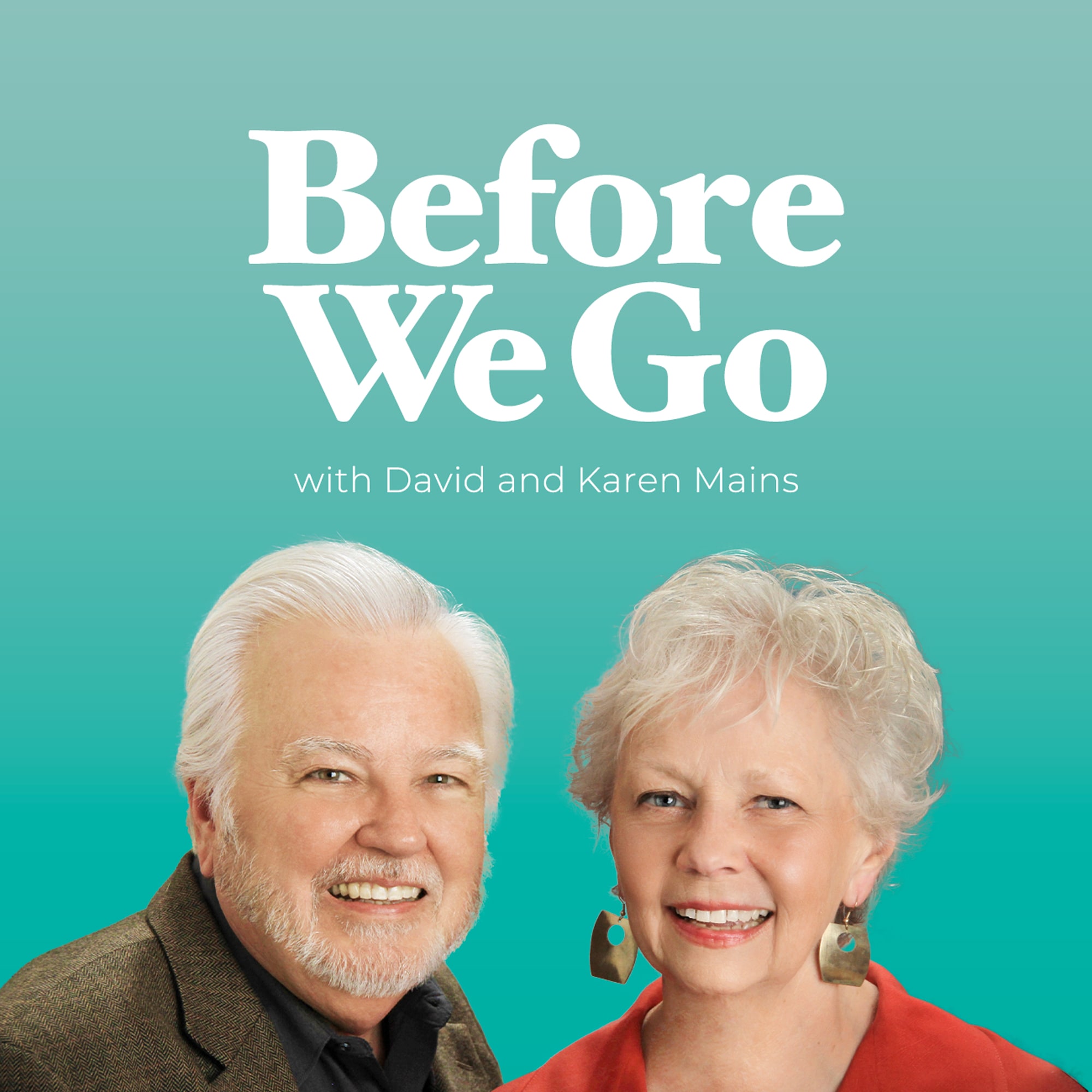
David and Karen Mains share from their experience how to work toward cultivating the engoded life—a life wherein we become more and more united with God and the characteristics that define Him.
Episode Transcript
David: The engodded life is the ultimate aim of the Christian journey and it requires rigorous cultivation.
Read More
David: Karen, you’ll recognize these lines, but let me say them anyway, okay? “What, will these hands ne’er be clean? Here’s the smell of the blood still. All the perfumes of Arabia will not sweeten this little hand.”
Karen: Lady Macbeth in the play by Shakespeare of the same name, Macbeth.
David: We’ll talk about it, okay?
Intro: Welcome to the Before We Go podcast featuring Dr. David Mains and his wife, noted author Karen Mains. Here’s David and Karen Mains.
David: Karen, I’ve seen that play so many times.
Karen: Well, we need to explain that. We have studied Shakespeare, not academically, but as a hobby, seeing the plays and we took ourselves and our families up to the Stratford Festival, the Shakespeare Festival in Canada, every summer.
David: I think for 30-some summers.
Karen: And so we have seen Macbeth in a variety of forms, variety of directors.
David: It’s done very well.
Karen: Yeah, beautifully done.
David: I remember sitting in one production of Macbeth and thinking to myself, “These poor people are struggling like mad. What if they came to me?”
Karen: Lady Macbeth and her husband Macbeth, who’s just killed the king.
David: What if they came to me and asked for help? What in the world would I say to them? Because this is heinous what they have done in their lives. Then coming to the place where I realize there are a lot of people in situations like this.
Karen: And Macbeth-like complexes.
David: My ministry even touches them because they’re at such a terrible place as far as what they have done and they carry that with them. “Will these hands never be clean?”
Karen: Yeah, I think a guilty conscience is an element that people struggle with a great deal. And they have a lot of shame in their lives or feelings of guilt or things that they have done.
David: Real guilt.
Karen: I mean true guilt, not just guilt-feelings.
David: With my experience being able to even help someone like this, I’ve wondered about that. I think probably what I would try to do is to take them to the cross.
Kare: That’s where I say there is forgiveness here.
David: There is forgiveness. It’s just overwhelming, the depth of what people do, and how do you somehow be redeemed in all of this?
Karen: Yeah, how do you find redemption? That’s really, really true. Well, I’ve seen you do that. Take a lot of people to the cross who had come to you for counseling, but who weren’t believers. And you’ve introduced them to Christ as He hung on the cross, dying for their sins. Those very sins that they felt.
David: They actually say, “Let us go there in our minds,” and then you look up at Christ. And you say, “This is what I’ve done. And I want to be forgiven. I want to be one of your followers. I want to hear from you that you’ve accepted me.” You know, you just wonder sometimes.
Karen: Right. That’s an extraordinary moment in time. And invariably, you’ll say to those people—I ask them, “Do you feel like He heard you?” And they always say, “Yes, David.” There’s never been a time when I’ve been present when they don’t feel as though something supernatural has happened in their life. So let’s talk a little bit about the beauty of a clear conscience, which of course the Macbeths didn’t have in Shakespeare’s play. And how do we achieve it? And how do we maintain it? How does that happen?
David: I’ve said, and I know that what I’m going to say is for more normal people, so I’m not sure how anyone could help the Macbeths without a whole different kind of conversation. But for the normal person…
Karen: The average, everyday person…
David: I would say that when you come to Jesus, you invite Him to enter your life. He doesn’t do that physically, but He does spiritually. And by His Spirit, He comes inside of you, washes you clean, and begins to teach you the new way of walking in love. Love for God and love for others. One of the early ways He will do that that you will notice is in terms of your conscience. He will start to correct you. He doesn’t speak out loud, but He makes you aware of His presence.
Karen: There’s a little check, a check in your spirit or a “uh-oh.”
David: Sometimes it’s more than a little.
Karen: It can be more than a little.
David: “You shouldn’t have said that.”
Karen: “Whoa, where are we going here?”
David: So what you want to do is to be open to that correction.
Karen: Pay attention to it.
David: The worst thing you can do is to kind of say, “Okay, I hear you, but get away, because I enjoy talking about…”
Karen: …saying bad things about that office worker who I can’t stand.
David: Can’t stand. Over a period of time, you can silence the voice of the Holy Spirit. Now, that’s the tragedy. The other side of that is that you can become quite adept at being obedient to the voice of the Holy Spirit.
Karen: And the more obedient you are, the more you are filled with the Spirit of Christ. Because the Holy Spirit is the Spirit of Christ that’s come to indwell us, or to sensitize us, or to instruct us in the ways of God.
David: Yeah, in fact, as you look at the names of the Spirit, you get a good idea of whether it’s God or not, and not just you thinking these thoughts. For example, the Holy Spirit is called the Spirit of Truth. And He will kind of work on your tongue so that what you say, you are satisfied that was the truth. I didn’t overstate it. I didn’t catastrophize.
Karen: Yeah, and curing what I call mouth disease. The tongue is more than just the tongue. It’s often the patterns of our behavior, or the patterns of our thinking that are very embedded in our lives. And that’s what the Holy Spirit comes to change. To make us more like God.
David: That’s a phrase that is not real common in evangelical circles. In fact, in other aspects of the church, the broader church than just evangelicalism, people talk about being in God, of showing God’s Spirit living in them to the place where they’re unusually holy.
Karen: Yeah, unusually holy. Noticeably holy to other people. People may not know what that is, but there’s sort of a radiance or something that begins to come from those people who really have walked with God through the years and who have made their lives attuned to that inner whisper.
David: These seem to be conversations from the earlier saints rather than the people who are the present heroes of evangelicalism.
Karen: Well, one of the things I would recommend for people who have been faith-based for a longer period of their lives, and not just new Christians, is to expose themselves to Christian theological systems that are different than their own. Not as an effort in saying, “This is where these guys are off, or they’re not theologically correct,” but as a learning process. And one of the great learning processes of my life was where I began to be exposed outside of American Christendom to truly faith-based people who lived in other parts of the world but had a church tradition that went back centuries before the Protestant Reformation. And that, David—you’re the historian—that would have been what?
David: Oh, you’re talking the 1500s.
Karen: And most of us in Protestant churches…
David: So you’re talking 1,000, 1,500 years. There is this great history of the church from the early church, up until the Reformation.
Karen: Right. And most of us don’t know very much about it.
David: Most of us meaning people with evangelical backgrounds.
Karen: Particularly people with evangelical backgrounds. So you were invited to go to the Middle East with a group of people who were trying to bring Christian leaders from the States over there to dialogue with leaders who were part of that more ancient expression of Christianity. And like many times in your life, I’ve often said, God opens the door for me and then David pushes me through it. Which is not a plan.
David: A compliment, or is it?
Karen: It is an extraordinary compliment. So you said, “I can’t possibly go. I have daily broadcasts.” And you were very tied up with that sort of stuff and all the responsibilities it took to maintain a daily national broadcast. But, “Karen’s the writer in the family, take Karen.” And so I went on this extraordinary journey to the Middle East starting in Israel. And in Israel, we met with the Christian leaders of Eastern Orthodoxy. So Eastern Orthodoxy is the faith practice that occurred in the early church. And it spread from Jerusalem around the Mediterranean. And eventually in time there was a divide between Eastern Orthodoxy and what became Catholicism. But so this is before the divide. I was absolutely blasted by their faith. I mean it’s been a suffering church. Eastern Orthodoxy has suffered. Russian Orthodoxy, a form of Eastern Orthodoxy, has suffered to maintain their faith under greatest trials. So they have been seasoned in a way that we in Western Christianity have not. And we praise God that we have not suffered like that. But then I came home and started to really read, as is my habit of doing the research then after the exposure. Read in Orthodoxy and I started to read the early works of the early church fathers. The best I could understand them.
David: This is a journey just incidentally that numbers of people have gone on.
Karen: Yes, they’ve been exposed to this.
David: They’re not leaving the Christian faith. They’re seeing the broader expanse of the Christian faith.
Karen: Right. So there’s a theology that is articulated a little more differently than the way we Protestants or evangelicals in the West would do. And that’s called the deification of man. And that’s really what they mean.
David: It’s going back to that term I think I used before, “in-God-ing.”
Karen: Being “engodded.”
David: Becoming more God-like, is that a fair statement?
Karen: Yeah. And the concept is that Christ became man in order that man might be made more into God’s image or be engodded or be—and they use the word deification. So I think that there is a lot we need to consider in that discussion. Because I think in Western, particularly American Christianity, with our great value of the independent person and of being independent and independent thinkers, we have lost some of the emphasis here in our own theology. We know that God wants to make us holy and He wants to make us like Christ. And the Holy Spirit has come to enable that process. But to think of being deified or re-deified, because we’ve fallen through the sin of Adam, is the thought process that takes us a little farther than what most of us are even comfortable with. But it’s a good process to be exposed to. And it has a lot to do then with how do we achieve and maintain a clear conscience, because they are much more diligent in the application of their theology of working at that.
David: So what I need to do is to say to the Macbeths, “You know what? I’ll take you to the cross, and then I want you to meet some Eastern Orthodox Christians.”
Karen: They’ll really tell you how to do it. I think the difference of the language and some of the thinking then helps us to consider where we are in our own process. And we stay in our own process, but we learn from these other peoples. One of the things that I’m impressed by is the diligence with which these early church fathers applied this reality to the way they lived. It was being established in a life of prayer, not just a little pattern of prayer that we slip in: “We have this morning for prayer, this hour for prayer, we pray before meals,” or whatever it is. It was—they meant what they said—a life of prayer that was given to prayer. And then there’s a concept of “You can’t do it on your own.” And I think we do have a lot of solo Christianity in our thinking as evangelical Americans. But so you would either make a journey of faith with people of similar passion and you would help one another establish this ideal of being engodded in this way, or you would have what we call now a spiritual director, someone who is in the faith process who is beyond you and much more mature. Now this was not incidental stuff as far as I understand it from my reading, because evangelicalism has moved more toward people who are trained as spiritual directors and we’re learning that from other Christian faith traditions. But in early Christendom, the early couple centuries, there was dedication to this concept and the seriousness about it that I don’t think we have even yet. It was more of a… that you must have this in order to mature.
David: So with the Macbeths, I’m understanding yes, there’s the initial entry into the faith. We’re at the cross. They would invite Jesus to forgive them of all their sins, but there would not be then just saying, “Okay, here’s a New Testament, you know, read this when you get an occasion. It’s good for you to establish a life of prayer,” which would be overwhelming. There would be the saying, “Now let us invite you into…”
Karen: “…this new life and we will walk along beside you.” Now we do have that concept of discipleship in evangelicalism which is a beautiful concept, so it’s not that it’s not there. It’s just a different kind of intensity.
David: You’re talking about something other than discipleship. You’re talking about a part of other members of the faith. You’re growing together. Caring for one another and especially for deeply troubled people. Because there are more than—I mean Macbeth is make-believe in a sense—but there are people who have terrible, terrible backgrounds and it is important for them to have others walk beside them. And to in a sense put their arm around them and say, “You’re going to make it. I’m there. I’m not leaving you.”
Karen: And to teach them about the intricacies of that faith walk and to teach them about what it means to be truly engodded and becoming like Christ, and to use their terminology, to be deified. There is a serious intentionality about that spiritual growth that I think is an extremely attractive one. And again, look at that under the context of persecution. I will emphasize again that Eastern Orthodoxy has suffered for being Christian. I mean that church…
David: Well, the Russian Orthodoxy was almost wiped out of the country.
Karen: That branch of Christendom was sweeping across the Silk Road.
David: You’re talking very early.
Karen: Early centuries. I mean just sweeping, and then there was the rise of Islam and its persecution that halted that sweep and then pushed it back out of that whole Asian area. So, historically, a really interesting thing as far as the way it was halted, but it was just galloping across those land masses in the early centuries after Christ.
David: So then the huge conflict where Islam and Christianity clashed and Islam won in many ways.
Karen: Yeah, it did. Yeah, it did in many ways. So what are we saying here?
David: Well, I’m processing and I’m thinking if I leave the theater, fortunately no one’s gonna call me and say the Macbeths need some spiritual help. “Can you get me? Can you be a benefit to them?” Because I would be overwhelmed. You know, I don’t minimize what Jesus can do, but at the same time I know that the church is going to have to put their arms around these people and some of what will happen, nobody knows. You know, what does that mean for their lives? Once they have confessed before God they have sinned previously. So where does society take over? I don’t know.
Karen: Yeah, but the history of the church is the salvation of the reprobate. People… I mean the slave trader who had made his living off of the encapsulation of black people and then selling them. The story of redemption is a story that touches all kinds of reprobates. That’s the beauty of it. That’s the joy of it. That’s the amazement of it. I have a memoir class where people are writing memoirs out of their life and I’m teaching it in this last group of people. Oh my goodness, David. One of the gals is an ordained minister and as she was seeking the Lord’s will in her life He told her that He wanted to start a church called New Directions. I mean she heard this through that inward system and so she said that’s exactly what she would do, but realized that what He meant was she was to take in the people who had been imprisoned and other places would not take them. They’d been released from prison.
David: Well, they wouldn’t take them because they were afraid of them.
Karen: They had a background. Those who were on drugs or selling drugs. I mean she went down this list. This is my last memoir class this week. I was reading her memoir. Her whole church is filled with people like that.
David: They’re filled with Mr. and Mrs. Macbeth.
Karen: Mr. and Mrs. Macbeth, and it’s called New Directions. You know, I said, “Oh, New Beginnings.” Thank you, darling. I said, “Oh, Liz, this is something that needs to be…” I mean this was a memoir piece, four pieces long, and I’m getting this story from… I said, “This is a story that needs to be told broadly because there are all kinds of people like that that feel like they’re not good enough to go to the church, or, you know, have a background or personality difficulties that are still manifesting themselves, but they want to be new. They want to be different. They want Christ in their life. They want to be engodded without even using those words, and that’s what this just is doing.” It was just an extraordinary exchange.
David: We try to get into a sentence these conversations we have, and this is a hard one.
Karen: We worked at this one, didn’t we?
David: “The engodded life is the ultimate aim of the Christian journey and it requires rigorous cultivation.” I’ll say it again, okay? We’re not used to those words; even writing them down was difficult for us. “The engodded life is the ultimate aim of the Christian journey and it requires rigorous cultivation.” Rigorous cultivation not only on the part of the individual entering into that life but on the part of the leadership of the church. This is not going to be an easy road. The Macbeths are going to start attending our church.
Karen: They have heinous crimes in their background.
David: Yes, and we’re going to help them learn to walk the way of Jesus. I hope you understand what I’m saying because this is going to be quite a time, but I think we can do it. Well, that’s the story of the church. I had to be careful how I say this because I don’t want to put down people, but it’s going to take more than just coming to the front and praying a prayer. These people will revert to old ways if we don’t embrace them wholly and say, “You know, you are now part of the family and we will learn together.”
Karen: You teach them what it means to confess their sins. You teach them what it means to receive forgiveness. You teach them what it means to have regular times set aside for prayer, to develop a life of prayer, and ourselves as well as we’re teaching them. You teach them how to set aside a time for self-examination to go before the Holy Spirit and say, “What are things I need to know that you’re trying to tell me?” “You mean I have to take care of that?” These are the things that have to be taught, and you make sure that they’re in an accountability relationship of some sort, either in a small group or with a wise spiritual teacher. That’s the rigor of being engodded.
David: What is the other option? I guess the other option is to say, “You guys are too far gone. Yeah, it’s just too much for us. We can’t handle that.” No one is ever too far. And then you throw away all the incredible stories of the work of God in people’s lives. Right. But it’s tough, isn’t it? It is a tough deal. I would like it if I could go to a place and just when it’s all over walk out and say, “Oh, glad that’s over,” and not even think about it.
Karen: Not think about the Macbeths anymore.
David: “What are we going to do with these guys? Who is somebody in our church who could begin the discipling process?” It’s a wonderful story, isn’t it? The whole of what God is doing and His ability to change people in the most remarkable ways.
Karen: Well, and I think then the wonderful part of the story is how extraordinary it can be. You know how extraordinary it can be. We’re not going to just settle for less than the best. God is wanting and pushing us to be more like Him, more like Christ, more—to use the phrase of the early centuries—more engodded.
David: One of the different ways, just to kind of bring all this to a close, that the Eastern Orthodox Church is from Protestantism—at least the way it’s practiced in a lot of the evangelical world—is that it has the church calendar, and we’re into a place now which we started with Ash Wednesday. Take it from there, okay?
Karen: Well, we’re in Lent.
David: Yes.
Karen: I mean this is a very appropriate conversation, this podcast, for this season. And in the church calendar, not the daily calendar, monthly calendar…
David: January, February, March…
Karen: …the church calendar, a season set aside before Easter for a period of self-examination.
David: So when Easter comes, there’s great rejoicing.
Karen: …and rejoice over the resurrection of Christ. But you’ve done all of this labor in this very intensive time that’s set aside in the church calendar for self-examination, for going before the Lord, for seeking scripture, for saying, “Where do I need to change?”
David: Those very wonderful practices can be trivialized as well. Everything can be messed up.
Karen: You hear people saying, “I’m giving up ice cream for Lent.” Oh, forget it, you know? Yeah.
David: Well, that’s my response to these. That doesn’t seem like it’s all that significant, but this can be a very beautiful, beautiful and…
Karen: Holy time.
David: Holy and a growth-inducing time in someone’s life. So just be open. The church is very broad and there are a lot of things that can be learned outside of just my background, my experience. The church is far bigger than me, is bigger than you, and God has worked in numerous ways. The engodded life. I like that term. Yeah, engodded life. Yeah, I am not there yet, but I’m in the process.
Karen: We’re asking God to do… to engod us.
David: Yeah, “The engodded life is the ultimate aim of the Christian journey.” We say it in different ways—that Christ would be seen in me and so on—and it requires a rigorous cultivation. I would say that I’m probably on a scale of 1 to 10, I may be up to a 2 or 3 at this point. Where would you put yourself?
Karen: I’m not going to answer that question.
David: I put it low because I think you would probably say 8 or 9. I would say, “Oh man, I’ll… I forget it.”
Karen: That’s between me and Him.
David: You’re back into the individualism now. I’ll let it be. Thanks for joining with us. Sometimes when we talk about “Before We Go,” it’s very indicative of the fact that we’re still in the learning process, right?
Karen: Right.
Outro: You’ve been listening to the Before We Go Podcast. And if you would like to write to us, please send us an email at the following address: hosts@beforewego.show. That’s all lowercase letters: hosts@beforewego.show. If you’ve enjoyed this podcast, please remember to rate, review, and share on whatever platform you listen. This podcast is copyright 2021 by Mainstay Ministries, Post Office Box 30, Wheaton, Illinois, 60187.
Leave a Reply